
This week, Vincent handed me the reigns of performing some palpation on various patients. What is palpation, you may ask? Palpation is a method of examining the body using one’s fingers and hands, usually to perceive or diagnose a particular illness. This is sort of a leg up from the stretches/exercises I performed on/with patients as I now begin to assume a more therapeutic role. Often time’s, palpation is best executed by applying lotion or cocoa butter to the skin (which I did this week :-)). Essentially, this allows for smoother “hand-work” on the body, further facilitating the diffusion of tension out from the afflicted region.

Vincent also allowed me to prescribe some of my own exercises to several patients during their clinical sessions :-). Basically, he would have me call patients back from the waiting room, seat them on a table, and take down their subjective (just a fancy word for an evaluation form – how the patient’s feeling, any pain that’s concerning them, etc.). From there, it’d be up to me to either assign them to some stretching or have them perform certain exercises. For example, a patient came in yesterday having problems with her posture. She was somewhat of an elderly woman and of course with years of sitting and standing with improper posture, her shoulders began to shrug and her back began to hunch at an extreme degree. As a result, this accumulates slight back pain and a decreased height. See, the body will always want to take the path of least resistance, causing many people to shrug their shoulders and hunch their back because it’s easier than constantly standing up straight, keeping your chest out, and all the other mechanics for proper body posture. Therefore, it’s mandatory for you guys to fight gravity and make sure you’re always walking and sitting with a tall posture so that you won’t be regretting it later on in life. And remember, it may feel awkward at first, but gradually your body will become comfortable with it as it develops into muscle memory :-).
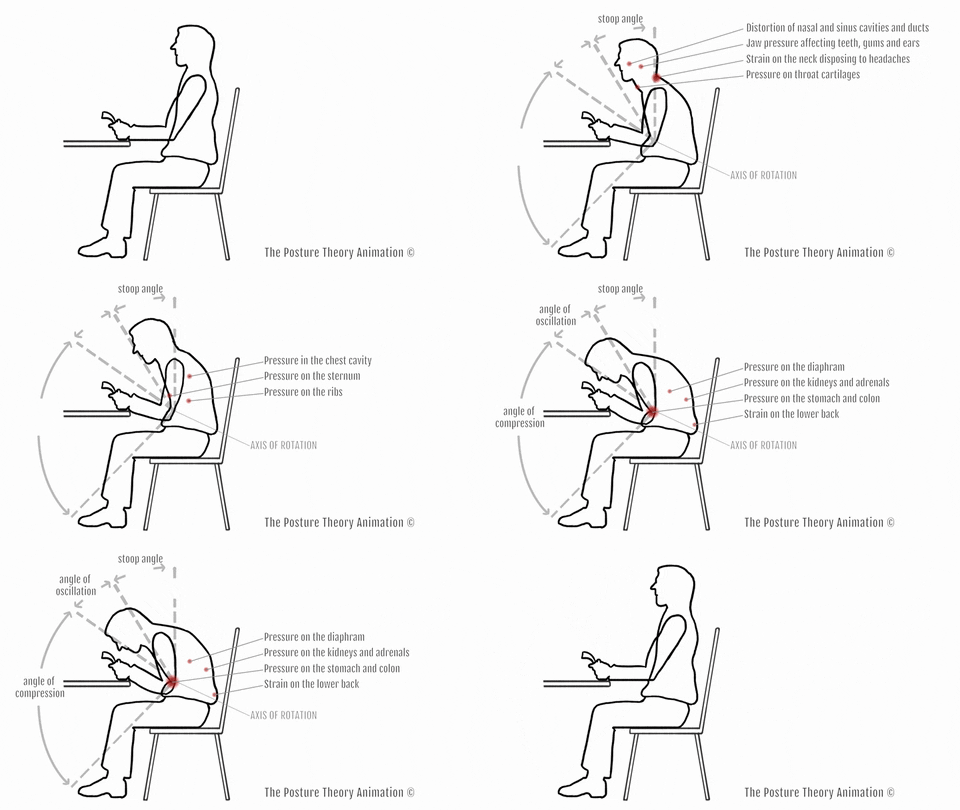
Annnyyyywaaayyssss, sorry about that tangent, but let me get back to my example. So for this particular patient, I had her do scapular retractions with a band. Basically, she would be tasked with holding out the band in each hand with both her arms straight out in front of her. Thereafter, she would bring her shoulder blades back and pop her chest out without bending her arms at all, keeping her glutes tight, abs in, back straight, and chin up. I know, I know, there are so many little nuances to what appears to be a very simple, straightforward exercise. However, each intricacy is necessary in terms of actually making the exercise effective. Now, why did I choose scapular retractions? Well, for a good posture, the back should be straight and the chest should be prominent outwards. In this case, these retractions eliminate any shoulder shrugs as the shoulder blades are progressively being pushed back (this all while the patient is keeping his/her back as straight and his/her chest as prominent as possible). And finally at the end of the session, I asked her to practice this same scapular retraction motion at home, and hopefully she’s compliant and can achieve a nice straight posture in no time :-).

Also since we’re on topic, the compliance surveys have been going pretty well. The game plan is to accumulate all the data and compile it into graphs and tables. And from there, I’ll analyze the information and hope to establish a correlation between improvement/muscle functionality with compliance. Hopefully *fingers crossed*, I’ll be able to statistically prove that patients whom are more compliant tend to experience greater improvement and muscle functionality than those whom are not.

And yeah, that should just about do it for this week’s post. If you have any questions, please comment down below, I’d be happy to answer them and clear up any possible ambiguities. Thank you all for making it this far and have a wonderful weekend!!!